The Silent Symphony of the Void
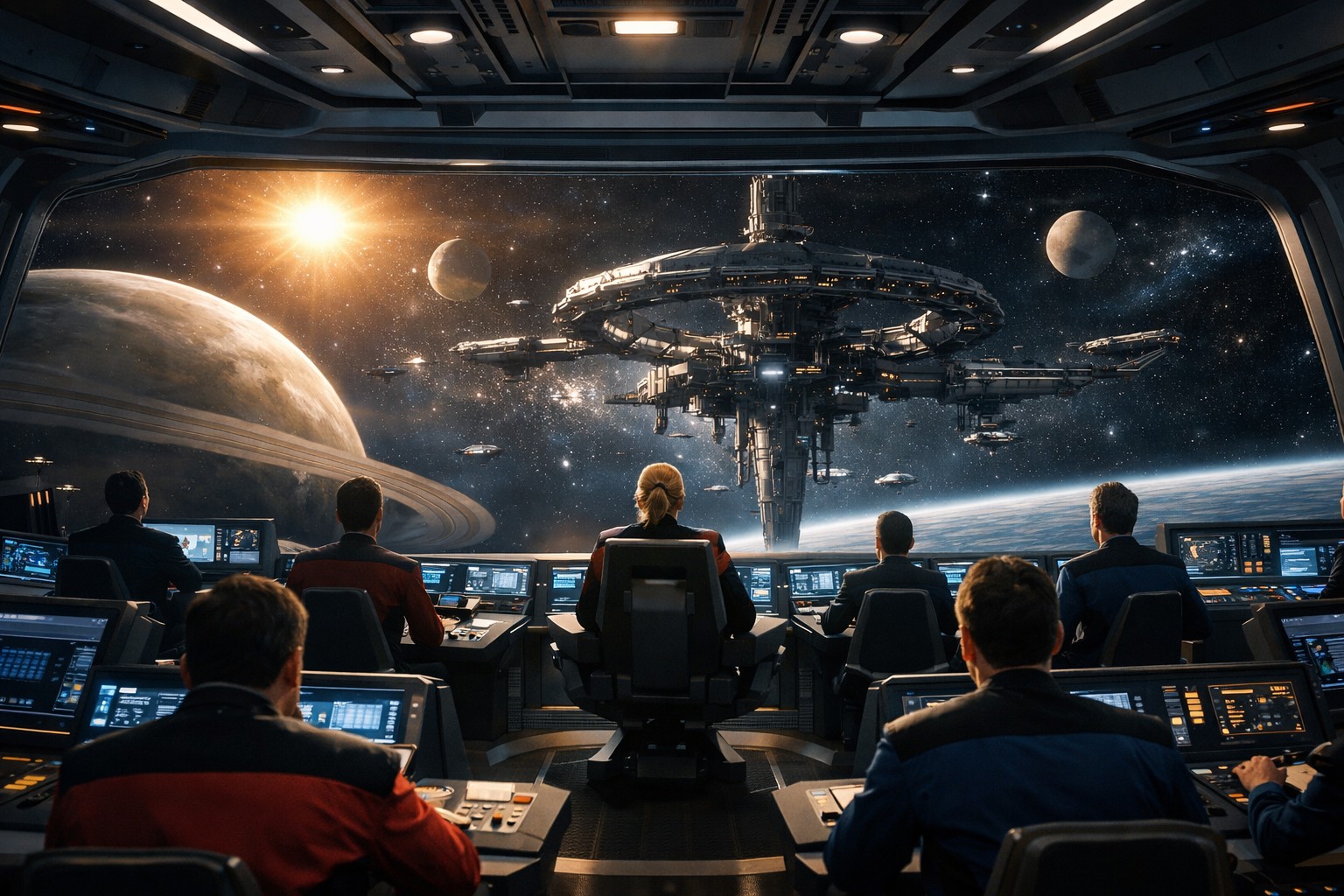
There is a silence on the bridge of the USS Aethelgard that is not merely the absence of sound, but the presence of focus. It is a heavy, electric quiet, broken only by the rhythmic chirping of telemetry updates and the subsonic thrum of the anti-gravity decking. Here, seated in the nerve center of humanity’s furthest reach, the crew does not just observe the cosmos; they manage it.
Before them, framed by the reinforced transparisteel of the panoramic viewport, hangs the Citadel of the Ninth Sector. It is a marvel of orbital architecture, a vertical city of docking pylons and habitat rings spinning in a slow, hypnotic waltz against the backdrop of the star-strewn abyss. To the left, the crushing gravity well of a gas giant—painted in bands of bruised violet and storm-cloud grey—reminds them of the indifferent power of nature.
Commanding the High Frontier
The Architecture of Interstellar Vigilance
At the center of the formation sits Admiral Vance. Her silhouette is rigid, a statue of resolve against the blinding flare of the local star. From this chair, she orchestrates the traffic of a thousand worlds. Small frigates and cargo haulers drift like dust motes around the Citadel, ferrying the lifeblood of trade between the inner systems and the outer rim.
The monitors before the crew glow with data streams: shield harmonics, approach vectors, and deep-space comms chatter. This is the intersection of high-stakes diplomacy and brute-force physics. Every blip on the radar represents a ship carrying thousands of souls, dependent entirely on the calculations made by the officers in this room. The Aethelgard is not just a ship; it is a shepherd dog watching over a flock of steel sheep in a wolf-filled forest.
Technology and the Human Element
Gazing into the Infinite
What defines this scene is not the cold machinery, but the human perspective. Despite the advanced AI running the fire-control systems and the fusion reactors burning in the engine room, the final decisions rest with the biological minds staring out into the dark.
The sci-fi dream of the mid-21st century has calcified into the reality of the 24th. We no longer look up at the stars and wonder; we look across at them and work. Yet, even for a seasoned crew, the view never truly loses its potency. The way the starlight catches the rings of the planet, the sheer scale of the station dwarfing the approaching cruisers—it is a daily reminder that humanity is small, but our reach is vast.
In this frozen moment, we see the essence of exploration: the calm professionalism required to live on the knife-edge of a vacuum, watching over the fragile expansion of our species into the endless night.