Paris has always known how to hold a gaze—through centuries of revolutions, expositions, and quiet mornings when the Seine turns silver under low cloud. But on the day the sky broke open, the city’s beauty became a target.
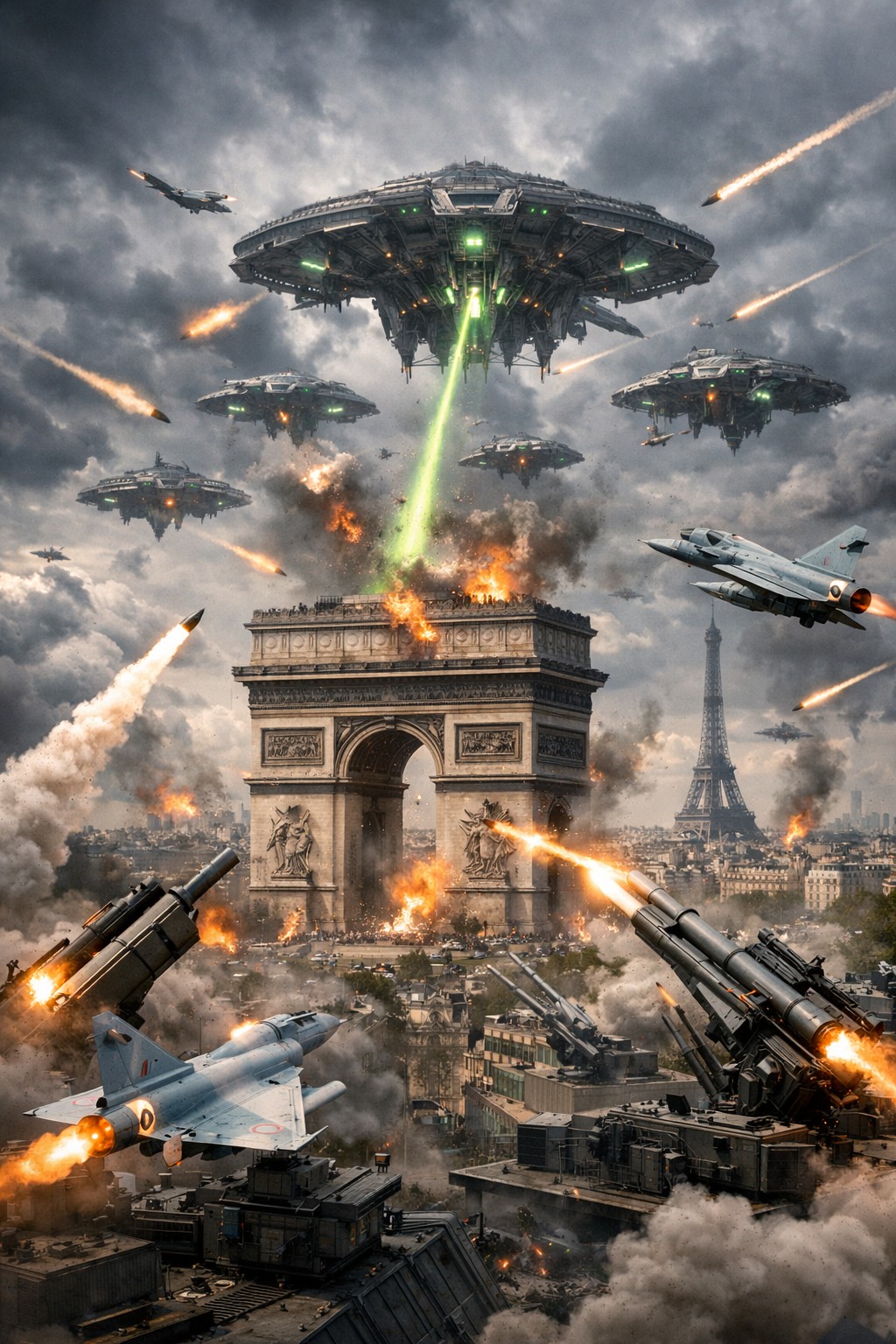
It began as an impossible geometry in the storm: dark, disc-shaped craft slipping out of the cloud deck with the silence of falling snow. They hung over the arrondissement grid like heavy punctuation marks, their undersides alive with cold green light. Then a beam speared down—an emerald column that seemed less like fire and more like a law of physics being rewritten. It struck the Arc de Triomphe dead center, and the monument’s pale stone flashed with heat as if the very memory of Napoleon’s victories had been selected for deletion.
Below, traffic froze into a sculpted snarl. People ran, not knowing which direction could be considered “away” when the threat came from the sky itself. Above, the air filled with contrails and alarms as French jets climbed fast, cutting through the smoke layers like needles through cloth.
Alien Invasion in Paris: The Arc de Triomphe Under Attack
The alien fleet moved with a deliberate calm that made it feel older than fear. Smaller disks spread outward to form a loose ring, while the largest ship remained above the Arc, projecting its beam in sustained pulses. Each pulse arrived like a hammerblow—stone turned incandescent, and shockwaves rolled down the Champs-Élysées, rattling glass and sending dust pluming from cornices.
Paris responded the only way a modern city can when myths become real: with networks. Emergency broadcasts stuttered across phones; public screens switched from fashion ads to evacuation routes. In the background, the Eiffel Tower—thin and iron-black against the burning cloud—stood like a tuning fork waiting for the next note.
There was no single “front line.” The battlefield was the skyline, and the airspace above it was suddenly crowded with machines that did not belong to any nation on Earth.
France’s Air Defense Response: Jets, Missiles, and Rooftop Batteries
As the first missiles streaked upward, the scene turned into a brutal ballet of angles and light. Rooftop anti-air batteries—improvised on government buildings and reinforced platforms—began to fire, their muzzles blooming orange. Fighter jets banked hard between the alien craft, threading gaps in a storm of debris and exhaust. Missiles rose in bright arcs, leaving white scars across the sky.
Some detonations flared too early, as if an invisible hand had pinched the explosives in mid-flight. Others found their mark and burst against alien hulls in bright blossoms—yet the disks did not fall. Instead, their surfaces shimmered and “healed,” as though the ships were wrapped in a thin, transparent sea that absorbed impact and converted it into heat.
The green beams returned in answer—clean lines that cut through smoke and cloud, puncturing rooftops and scattering defensive positions. Where the beams touched, flame followed, and then a deeper, darker smoke that smelled of scorched concrete and melted metal.
The Technology Gap: Green Beams, Gravity Fields, and Silent Command
The invasion felt coordinated beyond human tempo. The ships did not hunt like predators; they edited the city like engineers. Their beam lingered on infrastructure nodes—communications towers, transit junctions, and key road spines—suggesting strategy rather than spectacle.
Observers would later describe a strange distortion around the craft, a subtle bending of the sky like heat above asphalt. In that distortion, missiles drifted off course and drones lost signal. It wasn’t simply armor; it was control of local physics, a gravity field tuned to mislead guidance systems and exhaust pilots who tried to keep up.
And yet—Paris endured. Even under fire, the city’s logic remained: rescue routes opened, medical stations appeared in underground spaces, and the Metro became a moving sanctuary. Sirens, prayers, shouted directions in multiple languages—human noise rising to meet the alien silence.
After the First Strike: Paris in Smoke, Paris Still Standing
When the beam finally flickered and paused, the Arc de Triomphe was crowned in flame and dust, a wounded symbol framed by a sky full of enemy metal. Fighters continued to circle. Batteries continued to fire. The Eiffel Tower still stood in the distance, half-obscured by smoke, like a promise that the city’s spine had not snapped.
In that moment, the invasion stopped being a question of whether we were alone. It became a question of whether we could stay ourselves—whether art, history, and ordinary streets could survive contact with a civilization that treated monuments like targets and clouds like doorways.
Paris, battered and burning, answered with the only language it has ever trusted: endurance.