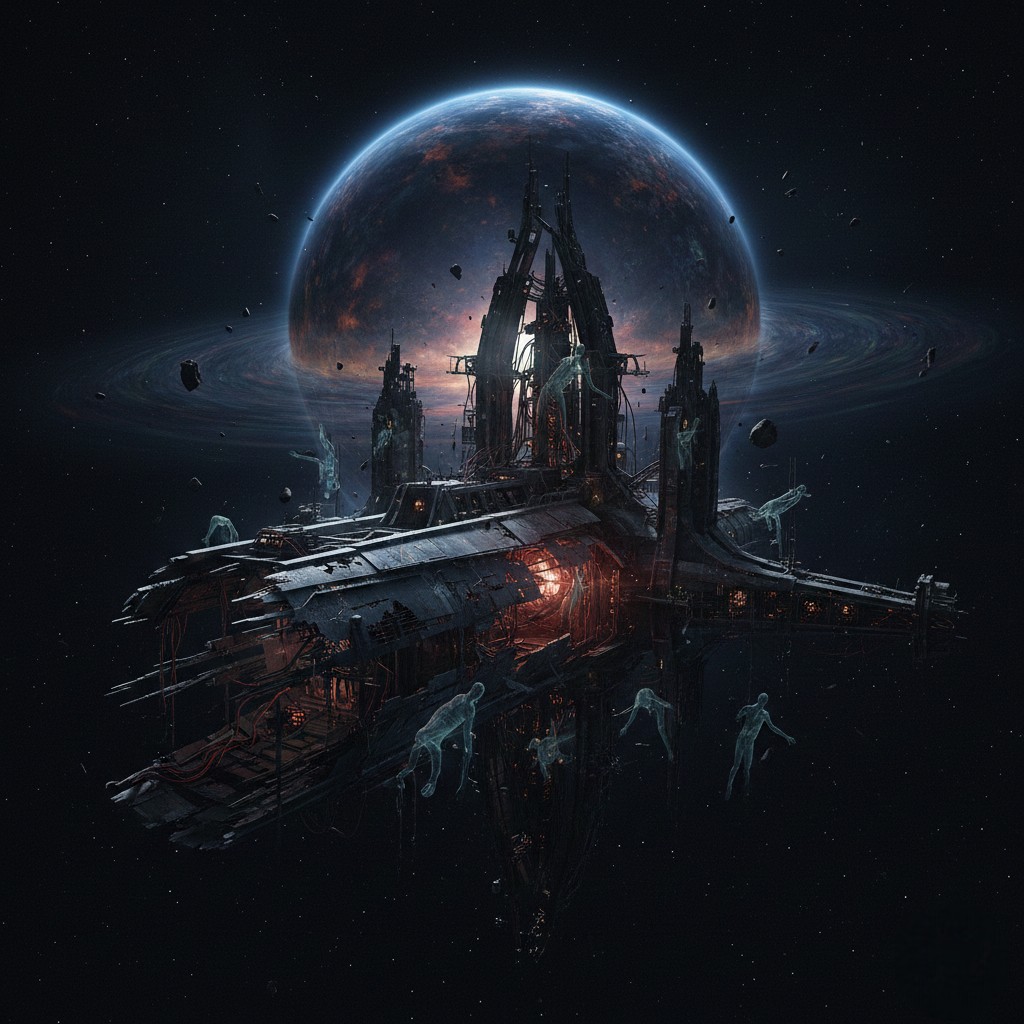
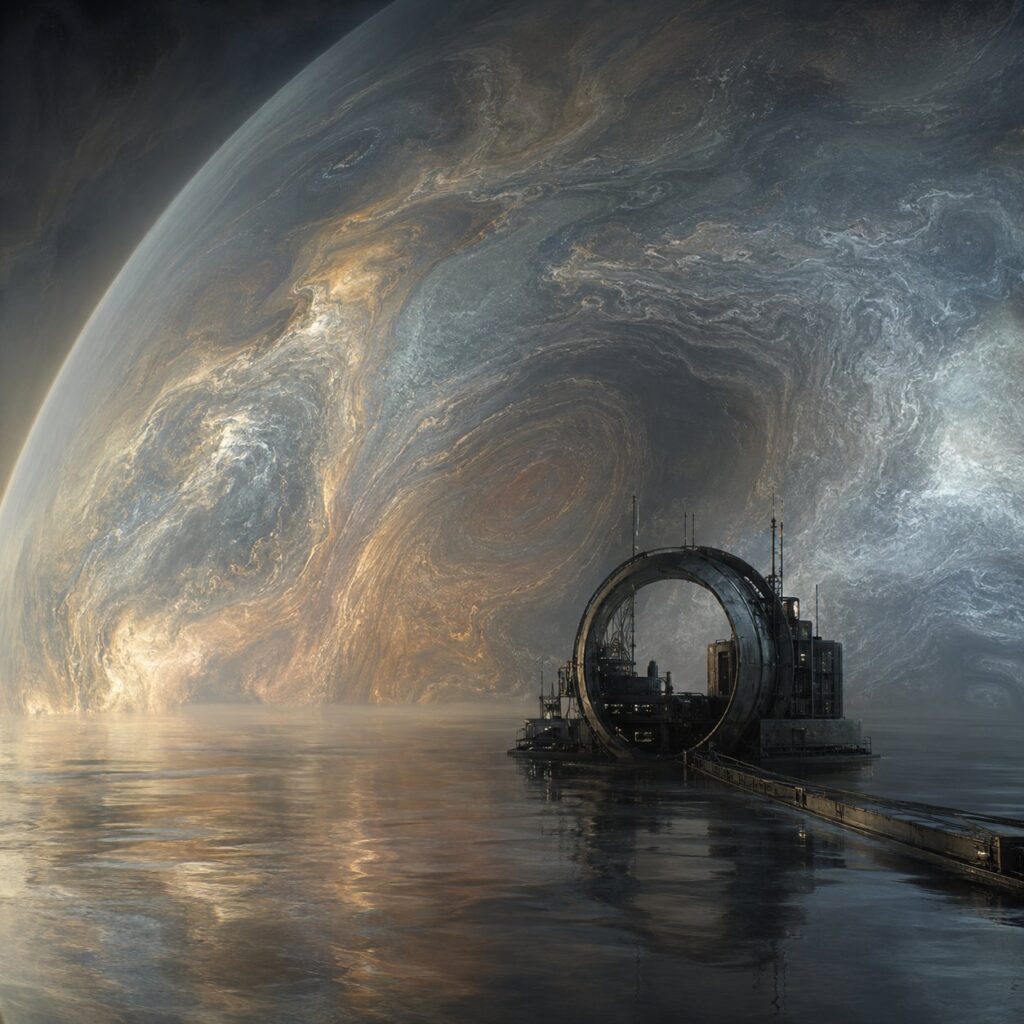
The first thing you notice on Saturn’s distant moon isn’t the cold. It’s the sky—layered, theatrical, and impossibly crowded. A swollen amber orb hangs low like a second dawn, while a darker crimson world floats behind it, heavy as a bruise. Smaller moons drift like punctuation marks across the upper atmosphere. Under that cosmic ceiling, the surface stretches out in ochre dunes and fractured canyons, where dust behaves less like sand and more like a slow-moving sea.
And rising from that sea are the spires.
They are not mountains. They are not natural. They look carved—deliberate, vertical, and sharply faceted, like the remnants of some colossal architecture that never needed to be friendly to human proportions. Their surfaces are dark and glassy, cut with faint luminous seams that glow in thin lines, as if power still trickles through veins of embedded circuitry. Between the spires, enormous bridgework spans the gaps: sweeping arches and elevated causeways that cross the canyon like the skeleton of a long-dead titan.
This is the Saturn-moon frontier at its strangest: not a settlement in the usual sense, but a place that feels like it was built for an idea—transport, control, and permanence—then abandoned before anyone could write the last chapter.
A Saturn Moon Landscape Built Like a Cathedral
Up close, the spires dwarf everything. They rise from the canyon edges with an architectural confidence that suggests an era when materials were either limitless or irrelevant. The geometry hints at layered construction: nested shells, buttressed ribs, and deep recesses that might once have housed lifts, docking collars, or atmospheric vents. Some edges shimmer with residual luminescence, an icy teal that flickers when dust storms pass—like static responding to a forgotten grid.
The bridges connecting them are even more unsettling. Their arches are too perfect to be erosion, too elegant to be merely functional, and too massive to be human-scale infrastructure alone. They look like transit corridors designed for heavy loads and constant movement—something that moved across the canyon day and night, long before any modern expedition logged this region on a map.
The moon’s thin haze makes distances deceptive. Objects appear closer than they are, and the spires seem to drift in the atmosphere like mirages until you realize the truth: they’re real, solid, and unimaginably old.
The Lost Canyon Way: Where the Freight Once Traveled
In the foreground, half-buried in dust, sits a long, low vehicle—part rover, part cargo sled—its hull scarred, its lines softened by years of sediment. It looks like the kind of machine that would have run the canyon routes: carrying refined material from extraction pits to processing towers, or ferrying components between distant platforms. A tether line trails into the sand, snapped and stiff, suggesting it was once anchored during a storm or an emergency halt.
If this moon was ever an industrial hub, the canyon was its artery.
The bridges make sense when you picture convoys: automated haulers gliding on magnet tracks, climbing the causeways to avoid unstable ground, shifting cargo under the spires where cranes and docking rigs could grab loads without exposing them to the open surface. In a place where dust can infiltrate seals and temperature gradients can crack metal, elevating your logistics isn’t a luxury—it’s survival engineering.
Yet the canyon is quiet now. No beacon pulses for incoming traffic. No navigation strobes blink from the towers. Only the faint glow of embedded lines remains, like a city’s lights seen through fog after a blackout.
Why Saturn’s Moons Became Humanity’s Outer-System Frontier
Saturn’s moons are prized for what they hold: water ice for fuel and life support, hydrocarbons for manufacturing, rare minerals buried under ancient crusts, and the strategic advantage of operating near one of the solar system’s great gravity wells. Even if this specific region predates human arrival—or belongs to an earlier, forgotten attempt at settlement—its existence explains the logic that keeps drawing civilizations outward.
A megastructure on a Saturnian moon isn’t just a monument. It’s a promise of scale: that someone once believed the outer system was worth building into, worth connecting, worth defending. It suggests industry big enough to justify bridges the size of cities and towers built to last beyond the people who raised them.
And it raises the inevitable question: if the builders left, why?
The Silence After the Infrastructure
Explorers who visit places like this describe a peculiar feeling—less fear than dissonance. The spires feel inhabited by intention, even when they’re empty. The glow-lines look like they should be accompanied by hum and motion. The bridges look like they should carry traffic. The vehicle in the dust looks like it should be one of hundreds.
But nothing moves.
Only the sky changes: the amber world shifts position, the red planet deepens in color, and the small moons drift onward. Saturn’s distant influence tugs at everything, including the imagination. Standing in the canyon shadow, you begin to understand what a frontier really is—not just a new place, but a place where the past and future argue in the same breath.
This moon is still waiting. For restoration, for answers, or for the next civilization bold enough to turn silence back into signal.