
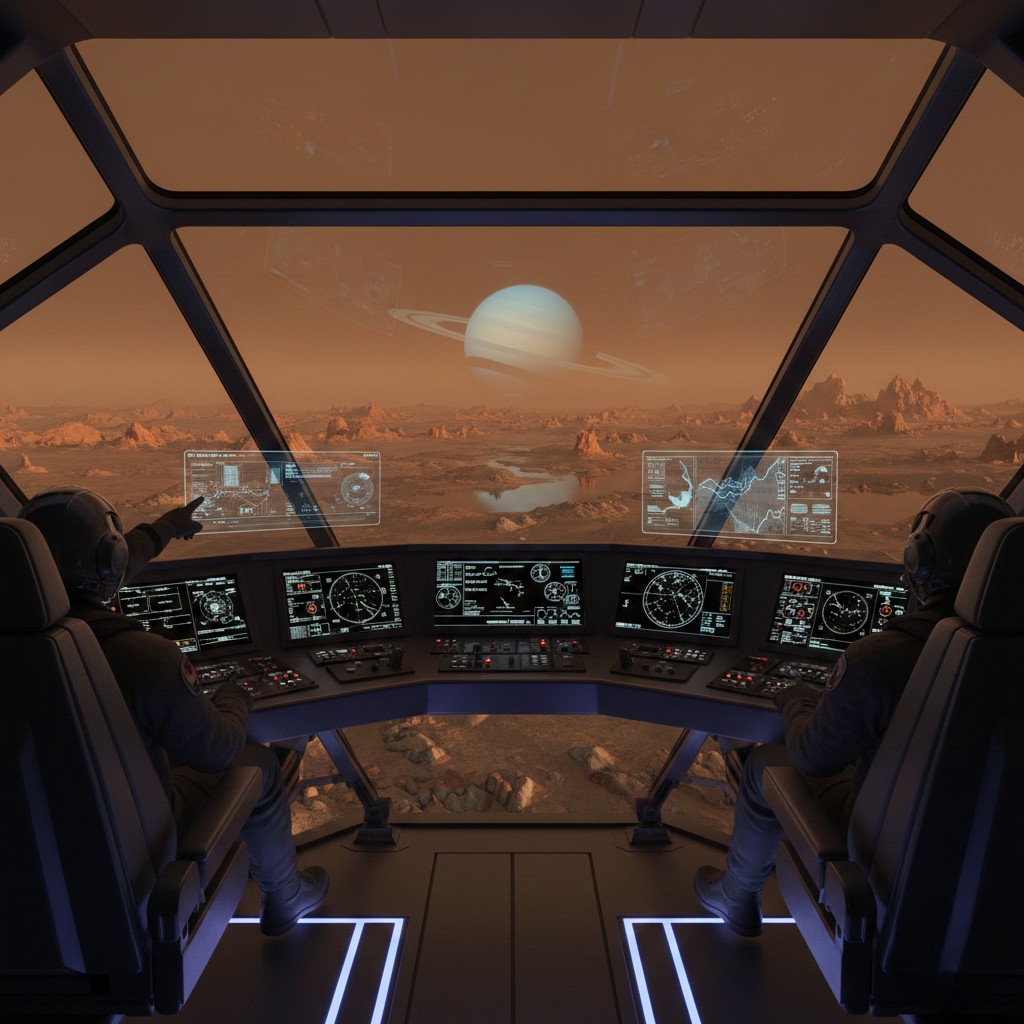
From within the cockpit, the alien world unfolds like a living map, painted in shades of amber and rust. Vast plains stretch to the horizon, broken by jagged formations and winding rivers that reflect the muted glow of a ringed planet hanging low in the sky. The cockpit glass frames the view with geometric precision, turning the landscape into both a destination and a calculation.
Inside, the control panels glow with layered data—topography, atmospheric density, gravitational drift—each display translating the unknown into something barely manageable. The ship hums softly, a reassuring counterpoint to the immense silence outside. This moment, suspended between flight and landing, is where exploration truly lives. Not in the arrival, but in the observation.
The planet beyond the glass feels ancient. Its surface tells stories of erosion, of water that once flowed freely, of climates that shifted without concern for visitors yet to come. The distant ringed giant dominates the sky, a reminder that this world exists within a larger, more complex system. Nothing here stands alone—not the rivers, not the rocks, not the explorers who now witness it.
From this vantage point, decisions are made that will shape the future: where to land, where to build, where to leave untouched. The cockpit is both sanctuary and threshold, separating fragile life from an indifferent environment. Beyond the glass lies mystery, promise, and risk in equal measure—and the quiet understanding that once seen, this world can never again be unknown.


