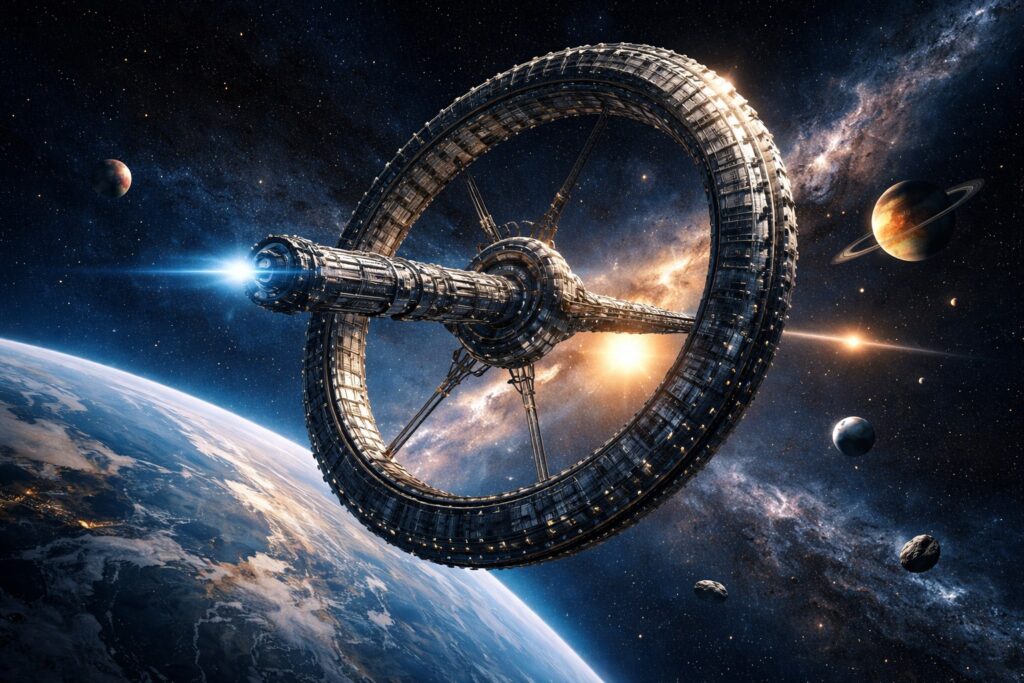
In Ridley Scott’s 2012 magnum opus Prometheus, a team of scientists and explorers aboard the spaceship Prometheus follow a star map discovered among ancient Earth civilizations. Funded by the Weyland Corporation, they journey to a distant moon, LV-223, seeking humanity’s creators—the enigmatic “Engineers.” What they find is a derelict alien structure harboring horrifying secrets that challenge everything about our origins, purpose, and place in the cosmos. The expedition becomes a fight for survival as the crew confronts not just alien terrors, but the devastating consequences of asking forbidden questions.
The Weight of Cosmic Questions
Prometheus elevates science fiction by embedding profound philosophical inquiry within its DNA. Unlike space horror that relies solely on jump scares, this film wrestles with existential dread rooted in legitimate scientific and theological debates. The screenplay dares to ask: If we met our makers, what would we say? What if they regretted creating us? This serious undercurrent transforms every scene into a meditation on hubris, faith, and the price of knowledge. The film doesn’t flirt with these concepts—it commits to them, forcing viewers to confront uncomfortable truths about creation, sacrifice, and abandonment.
Masterclass in Atmospheric Tension
Ridley Scott’s direction creates a suspense that festers rather than explodes. The terror in Prometheus is psychological: sterile chambers that whisper of ancient atrocities, holographic ghosts replaying forgotten disasters, and the creeping realization that curiosity summons consequences. The audience shares the crew’s mounting dread through lingering wide shots of the alien landscape and claustrophobic interiors where shadows seem to breathe. Every discovery promises answers but delivers darker mysteries, ensuring tension never dissipates—it evolves.
The Ultimate Puzzle: Where Do We Come From?
At its core, Prometheus is a detective story wrapped in cosmic horror. The Engineers’ invitation—a repeating pattern across millennia—promises revelation but conceals a warning. The film brilliantly captures humanity’s obsessive need to solve its own riddle, portraying scientists as both brilliant and blinded by ambition. Dr. Shaw’s cross necklace symbolizes this collision of faith and empirical pursuit, reminding us that our search for creators is as emotional as it is intellectual. The movie suggests that some puzzles resist solution because the truth might annihilate the seeker.
An Eternal Human Need
The quest for ancestral roots transcends culture and epoch—Prometheus understands this instinctively. From cave paintings to space travel, the film traces an unbroken line of human yearning to know “why we are here.” This isn’t mere academic curiosity; it’s a primal hunger for validation and meaning. Director Ridley Scott taps into this universal impulse, making the crew’s mission feel personally urgent for every viewer. We’re not watching strangers explore space—we’re watching our own deepest questions given form, thrust into darkness that answers only with silence or screams.
Why Prometheus Matters in Sci-Fi Cinema
Prometheus redefined modern sci-fi by proving that blockbusters could be visually spectacular and intellectually uncompromising. It influenced a generation of films (Arrival, Annihilation) that balance spectacle with substance. By treating its audience as adults capable of grappling with ambiguity, it restored gravitas to a genre often diluted by formulaic action. Its legacy lies in reminding filmmakers that the universe’s vastness is most haunting not when it threatens our bodies, but when it challenges our understanding of existence itself.