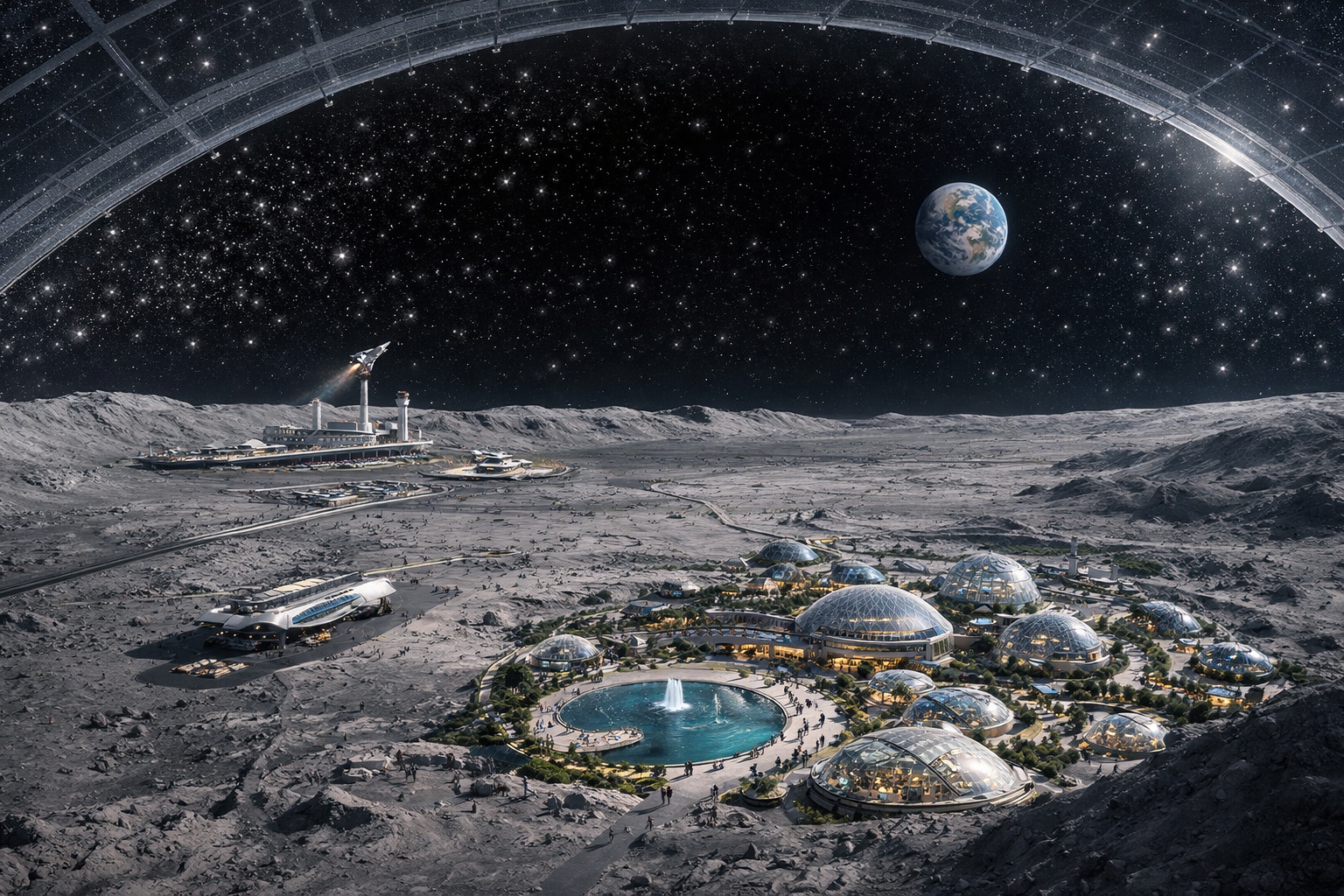
The year is 2222, and the Moon is no longer a place you only visit in documentaries or dream sequences. It has become a destination—bookable, curated, and astonishingly alive. Where the old Apollo footage once showed a silent gray wilderness, a new landmark now glows beneath a vaulted arc of orbital infrastructure: a sprawling lunar resort built into the cratered highlands, its domes shining like dew drops on basalt.
From above, the complex looks like a constellation fallen to the surface—clusters of transparent habitat spheres arranged around a central lagoon. The water isn’t a miracle; it’s engineering. Heated, filtered, endlessly recycled, and held in place by subtle gravity modulation and concealed field projectors, the lagoon is the resort’s signature: a circular pool of turquoise serenity set against the Moon’s stark monochrome. In the center, a fountain rises in a perfect plume, each droplet glittering like a suspended comet before returning to the surface in slow, graceful arcs.
Moon Resort in 2222: Luxury Living Under Domes and Artificial Skies
Inside the domes, guests stroll through gardens that would have been impossible two centuries earlier. Low-gravity palms sway beneath carefully tuned air currents. Rows of hydroponic orchids bloom in climate bands, their scents micro-dosed so they never overwhelm the senses. Pathways curve between glass canopies and warm-lit corridors, designed to ease newcomers through the disorientation of reduced gravity. Even the lighting is psychologically engineered—sunrise simulations that mimic Earth’s spectrum, gentle transitions that prevent the sleeplessness that once plagued early lunar crews.
The resort’s architecture is a fusion of elegance and survival: layered composites, micrometeoroid shielding, radiation-absorbing panels, and smart glass that tints automatically when solar storms flare. Beneath the visible domes, the true city exists in the sublevels—life-support arrays, water reclamation stacks, algae reactors, emergency shelters, and the quiet hum of industrial systems that make luxury possible in a vacuum.
To the left of the resort, a landing corridor and spaceport stretch across the regolith. Shuttlecraft glide in with controlled bursts of plasma, settling onto pads that shimmer with heat dispersion grids. Arrival is no longer dramatic; it’s refined. You disembark, pass through pressure equalization, and within minutes you’re holding a drink chilled by thermal sinks that vent excess heat into the endless night.
Earthrise Views and Zero-Gravity Recreation: What Guests Experience
What makes a Moon resort in 2222 different from Earth’s finest coastal escapes isn’t just the novelty—it’s perspective. Earth hangs in the sky like a living jewel, distant yet intimate, wrapped in cloud bands and ocean blues. From the resort’s panoramic lounge, guests gather for the daily ritual: Earthrise, framed by the lunar horizon.
Recreation is unlike anything on Earth. A morning jog becomes an elegant series of long, floating strides. Sports are reimagined—low-gravity tennis with slow-curving serves, aerial dance performances in dedicated “drift halls,” and guided excursions across the rim where visitors can bounce over ancient rock fields under a sky filled with stars unfiltered by atmosphere. There is no haze here, no scattering—just crisp starlight and the faint gleam of orbital rings overhead like a silver highway.
At night, the resort shifts into a different mood. Domes dim to amber. Music carries softly through interior courtyards. The lagoon reflects constellations with impossible clarity, and people who once feared space learn—quietly—that it can feel like home.
Engineering the Impossible: How a Lunar Resort Survives
A resort on the Moon is not simply a hotel with a view; it is a closed ecosystem dressed in elegance. The oxygen comes from electrolysis and bio-reactors. The water is mined from ice deposits and recycled through multi-stage purification. Food is grown on-site, supplemented by shipments from orbital farms and Earth. Waste becomes energy. Heat becomes power. Every molecule is accounted for.
The domes are anchored to bedrock and surrounded by berms of compacted regolith, protecting against radiation and micrometeor impacts. Autonomous maintenance drones—small, quiet, tireless—crawl across surfaces patching microfractures before they become problems. The resort is prepared for the Moon’s extremes: two-week days, two-week nights, dramatic temperature swings, and the ever-present risk of solar activity.
Luxury, in 2222, is not wasteful. It is efficient beauty—comfort built on careful math.
The Moon as Destination: Why 2222 Changed Everything
Two hundred years ago, humanity’s relationship with the Moon was heroic and distant. In 2222, it is personal. A lunar resort represents more than tourism; it proves that civilization can extend beyond a single world without losing its capacity for art, leisure, and wonder.
The Moon is still the Moon—silent, ancient, and indifferent—but within these domes, it has become a place where people celebrate anniversaries, hold conferences, watch Earthrise, and—perhaps most importantly—remember what it means to be explorers even when we are at rest.