The Crimson Veil of Mars: A New Frontier Awakens
In the perpetual twilight of Sol’s farthest child, where iron oxide paints the horizon in eternal rust, the Ares Ascent Vehicle stands sentinel. Towering like a monolith forged in the crucibles of human ambition, its pristine white hull gleams defiantly against the ochre dunes. This is no mere photograph; it is a portal to the stars, a snapshot of destiny etched in regolith dust. Picture it: the hulking rover, Pathfinder’s Fury, barrels forward on six massive treads, kicking up veils of fine Martian soil that swirl like spectral ghosts in the thin atmosphere. The year is 2147, and humanity’s prodigal children have returned to claim their inheritance.
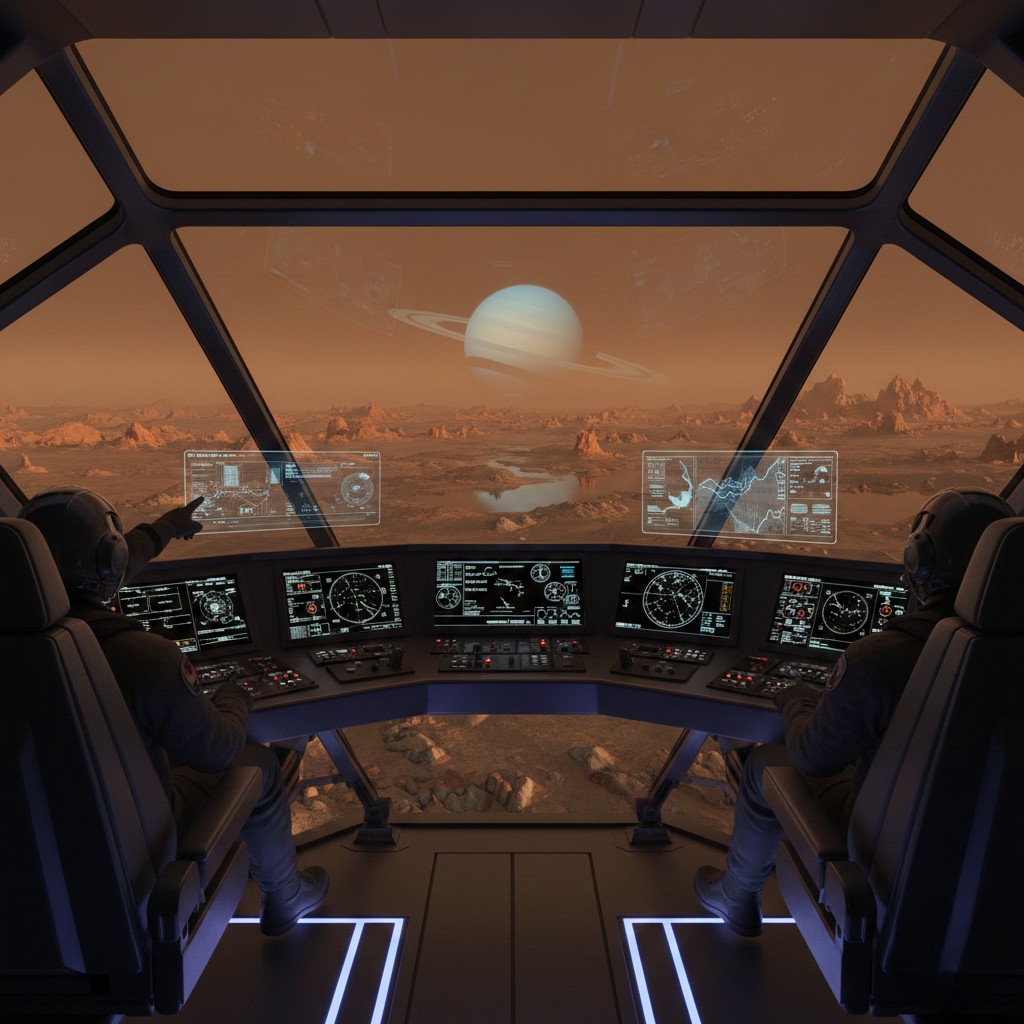
The air—such as it is—whispers secrets of ancient cataclysms through the rover’s comms array. Captain Elara Voss grips the control yoke, her gloved hands steady amid the vibration of hydraulic suspensions. Behind the polarized viewport, the launch tower looms larger, its gantry arms extended like welcoming claws. This is the Red Dust Odyssey, the saga of our species’ audacious pivot from cradle-world to cosmic wanderers.
Engineering the Impossible: Forging Steel Spines on Alien Soil
From Blueprint to Reality: The Ares Ascent Vehicle
Nestled at the base of the colossal rocket stands a marvel of xenotechnology. The Ares is no primitive chemical burner; its fusion-pulse engines draw from helium-3 harvested in the lunar shadows, promising escape velocity without the tyranny of fuel mass ratios. Its segmented hull, a lattice of carbon nanotubes and adaptive metamaterials, withstands the brutal thermal swings—from -150°C nights to scorching equatorial days. The open bay doors reveal the payload cradle: habitats, gene-banks, and the embryonic neural nets of AI overseers destined for Phobos Station.
But it is the rover that steals the scene’s thunder. Pathfinder’s Fury is a beast of brutalist beauty—orangutan hull plates scarred by micrometeorites, sensor pods scanning for subsurface volatiles. Six independant wheels, each a fortress of regolith-proof tires spun from spider-silk polymers, devour the terrain. Armored cockpits house a crew of five: geologists, astrobiologists, and one rogue quantum engineer whose illicit experiments might just rewrite physics.
This vehicular vanguard exemplifies the symbiosis of human ingenuity and Martian harshness. Powered by compact radioisotope generators, it hauls 10 tons of cargo—ice-mining drones, habitat inflatables, and the precious volatiles for propellant production. In the sci-fi annals of exploration, it echoes the hulking landers of Bradbury’s dreams, but amplified by Clarke’s orbital calculus and Asimov’s robotic precision.
Echoes of the Void: The Human Spirit Amidst Cosmic Desolation
The Psychological Frontier: Isolation in the Red Wastes
As the rover crests the final dune, the dust plume settles like a shroud. Inside, Voss’s crew exchanges glances through HUD overlays. Mars is not hospitable; it is a forge for the soul. Radiation sleets through inadequate shielding, psychological entropy gnaws at morale, and the dream of Earth—a blue marble receding in the rearview—fuels both hope and despair.
Dr. Kai Ren, the astrobiologist, pores over spectrometer data. “Perchlorates in the soil, but life’s signature lurks beneath,” he murmurs. Fossils? Microbial holdouts from a wetter aeon? Or something engineered by forgotten precursors? The sci-fi trope of ancient aliens pulses here, real as the rocket’s ion glow.
Yet peril shadows triumph. Subsurface quakes—marsquakes—could swallow the launch site. Dust devils, towering vortices of abrasive grit, threaten seals and solar arrays. And whispers from the Black Horizon Collective, rogue colonists who’ve gone feral in Valles Marineris, hint at schisms in humanity’s unity.
Ignition Horizon: Launching Toward the Stars
The Ascent: Humanity’s Next Evolutionary Leap
The rover halts at the gantry’s shadow. Robotic arms extend, interfacing with the Ares’ underbelly. Cargo unloads in balletic precision: cryosleep pods for the 50-soul crew bound for the outer belt, where Kuiper outposts await. Voss steps out, boots crunching regolith, saluting the tower as if it were Olympus Mons itself.
Ignition looms. Fusion flames will pierce the pink sky, arcing toward synchronous orbit and the Olympus Gate cycler-ship. This is no one-way ticket; in-situ resource utilization turns Mars into a gas station for the solar system. Propellant from polar ice, habitats from 3D-printed lavatubes—self-sustaining, exponential.
In this tableau, we glimpse the Red Dust Odyssey‘s crescendo: from rover to rocket, dust to destiny. It is Heinlein’s frontier reborn, Gibson’s sprawl extended to the heliopause. Colonization is not conquest; it is co-evolution. Mars remakes us as we remake it.
Why This Vision Matters: Sci-Fi as Prophecy
From Fiction to Fact: The Blueprint for Tomorrow
This image is more than pixels; it is prophecy. SpaceX’s Starship prototypes echo the Ares; NASA’s Perseverance kin to Pathfinder’s Fury. By 2040, boots on regolith; by 2100, cities in the hellas basin. Challenges abound—terraforming’s ethical quandaries, AI governance, the specter of solarian wars—but the thrust vector points upward.
Join the odyssey. Dream in regolith reds. The stars are not distant; they await our engines’ roar.